
Hurricane City Directory Collections
The most useful directory shelf is a mix of current civic listings and historical collections. The table separates a municipal contact list from a newspaper or yearbook, because each one proves something different. A city directory entry can place a person or organization in a particular edition. It does not prove ownership, continuous residence, or a present-day address.
| Collection | Years | Where held | Access |
|---|---|---|---|
| Hurricane High yearbooks | Verified 1928, 1930, 1931, 1938, 1941 | Utah Tech WASH-031 | Finding aid and reading-room rules |
| Washington County News | Corpus begins 1898 | Utah Digital Newspapers | Online search and page images |
| City staff directory | Current listing | Hurricane city | Public web search |
| City business directory | Current listing | Hurricane city | Names and categories |
| Utah City Directories collection | Regional collection, Hurricane run unverified | Utah institutional collections | Search finding aids |
The official negative finding matters. No continuous Hurricane city-directory or reverse-directory year range, publisher, or exact obituary index was located. A researcher should ask the library or archive for a title, edition year, call number, and access rule before promising a result.
What Hurricane City Directories List
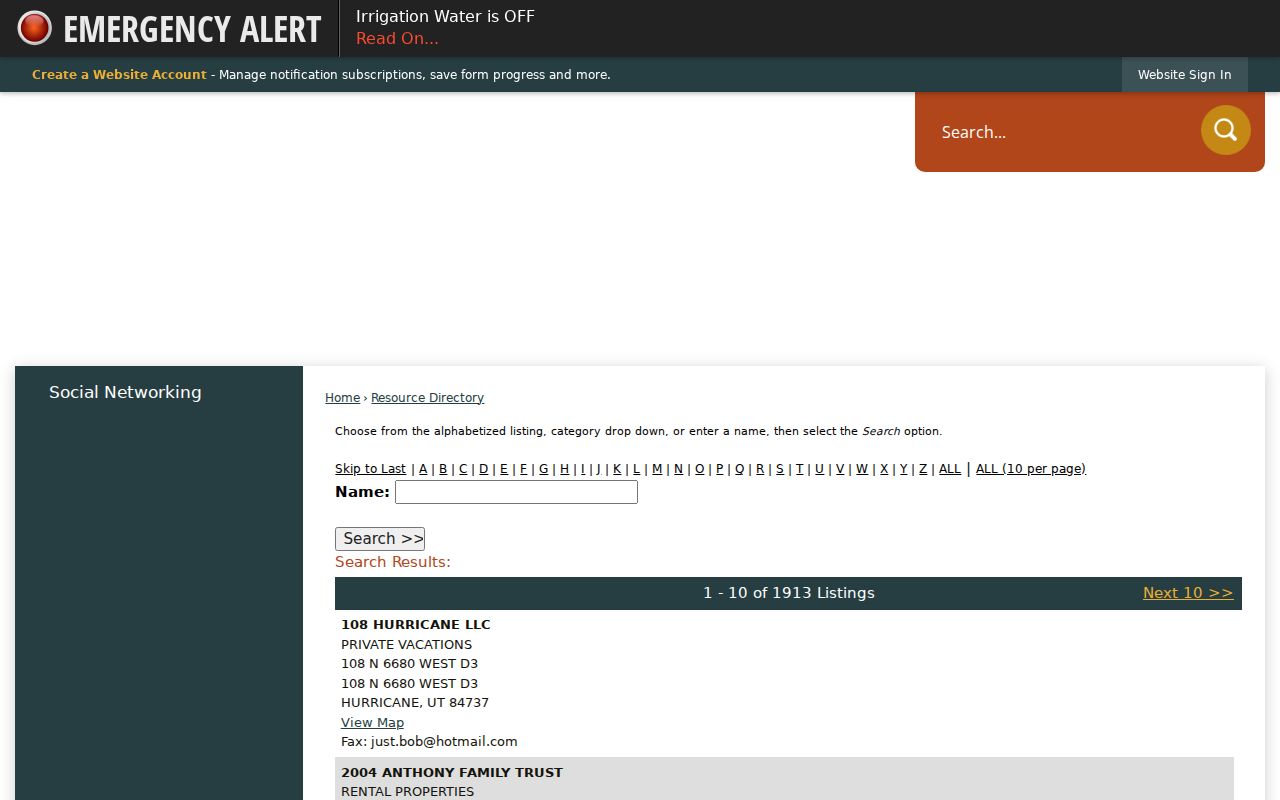
Hurricane’s business directory is the strongest current organization search. It provides A-Z or ALL filters, a name field, a category selector, and Search. It displayed 1,913 listings at inspection. Entries can include business name, category, address, phone, email, or fax. Date the inspection because listings and city-limit status can change.
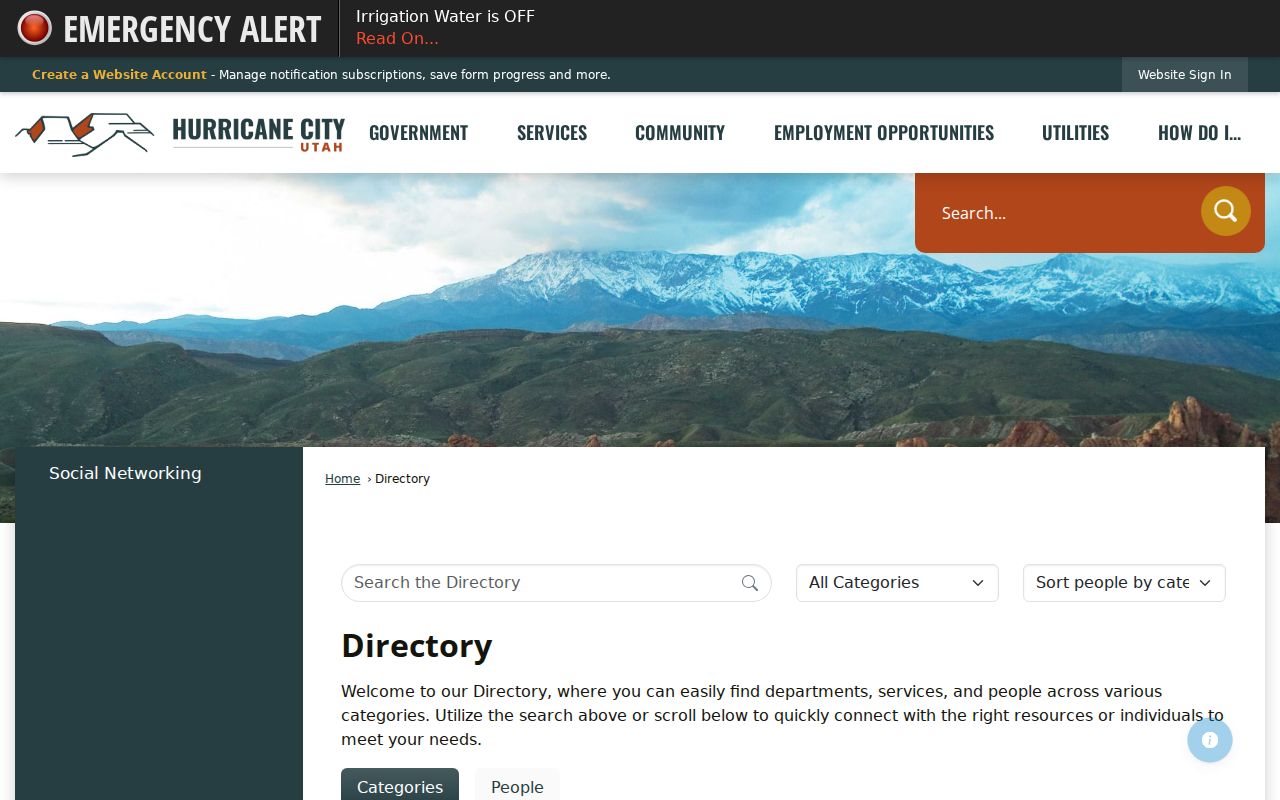
This directory helps with a business name found in a newspaper, a public meeting record, or a deed. It should not be relabeled as a residents directory. The separate staff directory accepts Category, First Name, Last Name, and Search. Staff records are useful for routing a public-record question to the right office.
The Hurricane business directory shows the city’s organization-focused search surface.
Searching Hurricane Staff by Name
The staff search is narrow but practical. Use a category when a record concerns the Recorder, city manager, cemetery, building, or another department. Use first and last name when a signature or meeting document supplies an official’s name. The result helps identify the custodian or signer; it does not establish a private address or family connection.
- Category
- Routes the search to a city department or role.
- First Name and Last Name
- Tests the public staff listing for a named official.
- Search
- Runs the city’s directory filter.
Hurricane city offices are listed at 147 N 870 W, with 435-635-2811 in the inspected material. The City Recorder handles current minutes, agendas, ordinances, contracts, oaths, resolutions, and records requests. Older city records are managed by the Utah State Archives, so a missing web item is not evidence that no record exists.
The Hurricane staff directory provides the department and name controls used to route city-record questions.
Hurricane Recorder Material
Municipal records can add names and places to a city directory search. The City Recorder says agendas and minutes are posted online for one year. Audio is posted through Utah Public Notice, with older audio available on compact disc for a fee. A request for older or other city records goes through Cindy Beteag at the city’s GRAMA process. Police-record requests use the police form and records email rather than the general Recorder route.
Match the record type to its keeper. A resolution may identify an official or organization. A contract may name a signer. A minute may mention a street or project. None should be read as a complete directory of residents. The city’s business-license page says licenses are required inside city limits and publishes examples of fees, but current requirements must be checked with the city.
Hurricane City Records for Places
The Building Department links to CityInspect and identifies the 2021 IRC, 2021 IBC, and 2020 NEC as effective July 1, 2023. Permits can supply address and applicant or owner evidence. The accessible official text did not expose CityInspect’s public search fields, historical coverage, or name display. Avoid describing a permit portal as a searchable resident directory until those controls are confirmed.
The Hurricane City Cemetery offers an online Cemetery Web Map with plot and interment information. Its page lists resident and nonresident plot and care amounts, opening and closing charges, transfer, and exhumation fees. Policies and fees can change. An interment result can support a family or burial connection, but it does not prove that the person occupied an address.
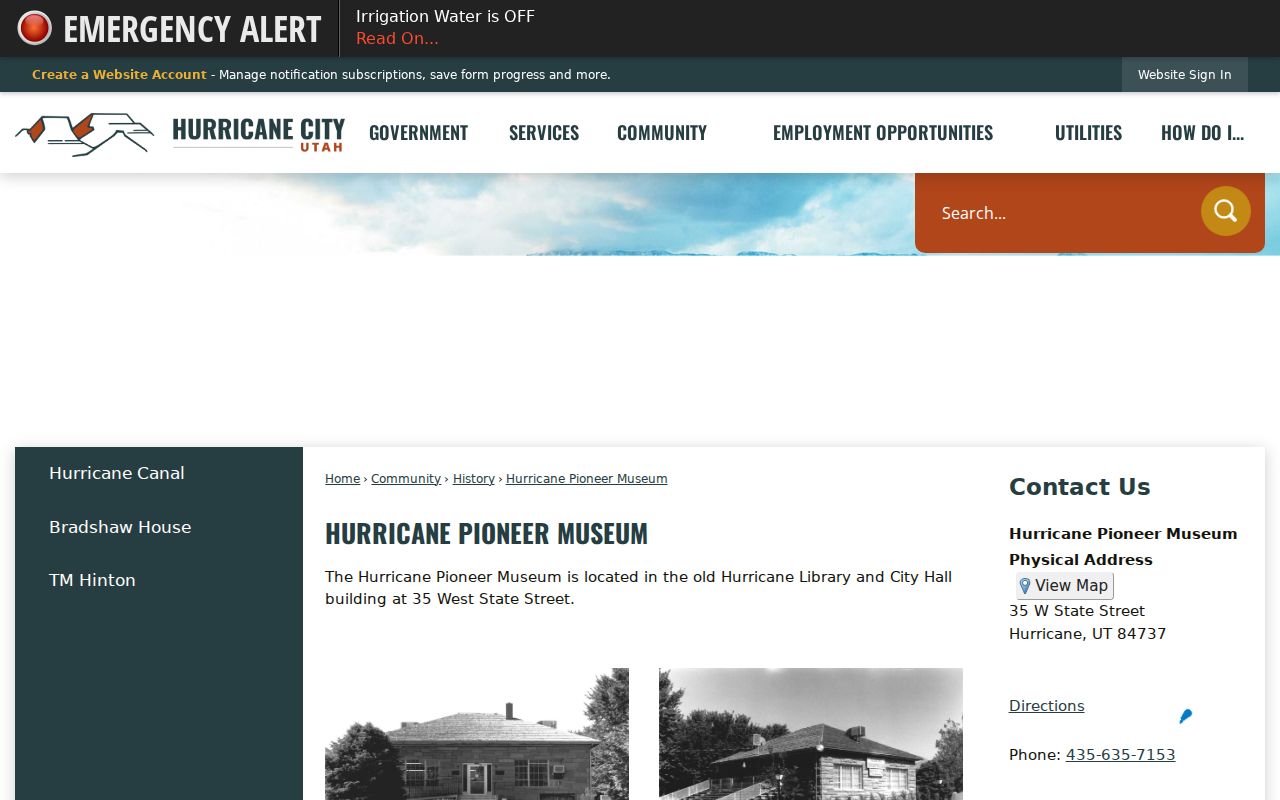
The Hurricane Pioneer Museum and cemetery resources are local institutional clues rather than one combined directory.
Hurricane City News as a Directory
The Washington County News corpus begins in 1898. The catalog may show St. George as the city facet even when the issue contains Hurricane local items. Search the paper and Washington County, then inspect page images for surnames, streets, wards, schools, canal references, marriages, births, and obituaries. OCR often misses the very letters that distinguish a family name.
A newspaper can put a name in a social or civic setting for one date. It cannot replace a deed, a vital certificate, or a current property record. Save the issue date, page, and URL. When a search fails, try a street, school, church, canal, or alternate spelling rather than restricting the catalog to Hurricane alone.
Hurricane High Yearbook Titles
Utah Tech’s WASH-031 finding aid verifies Hurricane High volumes under changing titles: The Cyclone in 1928, Fault Finder in 1930, The Hurricana in 1931, Red and Black in 1938, and Typhoon in 1941. A yearbook search that uses only the school name can miss a title-specific catalog entry. Search by title and year, then request the volume under the repository’s reading-room and photo-ID rules.
Yearbooks are strong for classmates, clubs, athletics, portraits, and a school cohort. They are weak evidence of a current address. Pair a historical name with the newspaper, a cemetery index, a birth register, or a deed only when the dates and identity details fit.
Hurricane’s Museum Records Story
The Pioneer Museum at 35 W State Street offers a useful local records story. The building moved through federal and state ownership, canal-company title, church and city use, library and police use, and city-office use before becoming a museum. WPA construction began in December 1938 and ended in February 1940. The pink hand-hewn sandstone came from near Berry Springs, about seven miles west, and the earlier civic uses continued until 1986.
That history suggests precise searches: the street address, Bishop Ira Bradshaw, the canal company, the 1932 deed language, and city minutes. The museum is a referral point for photographs and local memory, not a promise of a searchable person database. Keep a building story separate from a private resident claim.
How a Hurricane City Entry Reads
Before accepting a city directory result, write down the edition or access date and the exact field that produced it. A business entry records an organization. A staff entry records a public contact. A yearbook page records a student or activity in a school year. A newspaper item records what was printed. A finding aid identifies a collection. Each has a different level of detail and authority.
- Identify the collection title and keeper.
- Record the year, page, address, school, organization, or event shown.
- Check the image or original item when OCR or a summary supplied the lead.
- Compare the name with a second independent source.
- Label the result as historical context, organization evidence, property evidence, or a certified event.
The Hurricane Branch Library at 36 S 300 W is a current referral point. Its current page lists 435-301-7540 and weekday and Saturday hours. An archival library PDF places Washington County newspaper microfilm at the St. George branch, but holdings should be confirmed with staff.
The Hurricane Directory Gap
The official Utah City Directories collection is a regional fallback, not proof of a continuous Hurricane run. The Library of Congress local telephone-directory scope inspected did not list Utah. That makes Washington County News, WASH-031, the Historical Society index, State Archives inventories, and county property maps more important for local work.
The gap changes the workflow. Search the current city directories for officials and organizations, the newspaper for names in place, the yearbooks for school cohorts, and county records for an address chain. If the question concerns older municipal action, start with the city and then ask whether State Archives holds the historical file.
Use City Directories with Care
A Hurricane city directory search is most useful for family history, reconnecting with a classmate, understanding a civic organization, or tracing a house through a dated source. It is not a substitute for a certified vital record, a current parcel record, or a court disposition. An old address can show where a listing appeared in one year without proving ownership or continuous presence.
For a current person question, follow the Hurricane resident lookup workflow. For a street question, carry the parcel ID into the by-street search. For older households, compare the directory, the deed trail, and the newspaper while keeping the uncertainty visible.