
How Hurricane Residents Are Found
A useful search has a starting fact and a reason for choosing the next record. An address points first to Washington County GIS or the Assessor, while a name may be tested in the Recorder index, Utah Courts Xchange, the voter route, or a local historical collection. A school connection makes a yearbook more useful than a current property roll. A family event may call for a vital-record request rather than a general name search.
Public sources do not form one complete list of people. The property roll is about taxable parcels, the Recorder index is about recorded instruments, the voter file contains defined public fields, and a newspaper may mention a person without proving where that person lived. Unlisted household members, children, and people protected by a confidentiality program may not appear in a result. Treat each hit as one piece of evidence.
- Write down the name, address, ZIP, school, or event date that is already known.
- Use the county GIS or Assessor view to identify the parcel and its account details.
- Use the Recorder search to connect the parcel, legal description, names, and recorded dates.
- Check Xchange, voter information, newspapers, or yearbooks only when the question fits that source.
- Save the official URL, access date, and record label before drawing a conclusion.
Where Hurricane Resident Records Sit
Many Hurricane searches route to St. George because Washington County is the custodian. The Washington County Recorder/Surveyor maintains recorded instruments, cross-reference indexes, plats, and historical-document links. The Assessor handles taxable property and supplies a parcel or address bridge. County GIS adds the map layer, while the Clerk handles marriages, elections, business-license functions, and GRAMA intake. Hurricane’s own Recorder handles current municipal material, with older city records routed toward the State Archives.
Washington County GIS
Parcel, layer, abstract, and plat tools
Countywide online viewer
Washington County Clerk
Marriage, election, business, and GRAMA routes
County service desk
These offices answer different questions. A Recorder name can identify a grantor, grantee, trustee, lien claimant, or another party, not necessarily a resident. An Assessor or Recorder viewer can tie a name to a parcel, but a mailing address may be outside Hurricane. A city staff page identifies public employees and contacts, not every person in town.
Hurricane Parcel Search Before Names
The county GIS quick-start material verifies three practical search routes: Account Number, Parcel ID number, and Address. Begin with the address if the question concerns a current place. Keep the account or parcel identifier once it appears. That stable value is more reliable than copying a street spelling from an old clipping, and it can be carried into the Assessor view, the Recorder’s legal-description fields, and a later map check.
| Starting field | Account Number, Parcel ID number, or Address |
|---|---|
| Useful result | Parcel location, tax/account context, and map position |
| Next bridge | Recorder parcel, subdivision, lot, block, unit, or legal text search |
| Record caution | Owner, mailing address, and occupant are different facts |
The county GIS inventory also links a Recorder’s Office Viewer and an Assessor Record Search Viewer. The map can show parcels, subdivisions, street centerlines, city limits, flood zones, and zoning. Those layers help place an address. They do not turn the map into a household roster, and they should be read with an as-of date because parcel and owner data change.
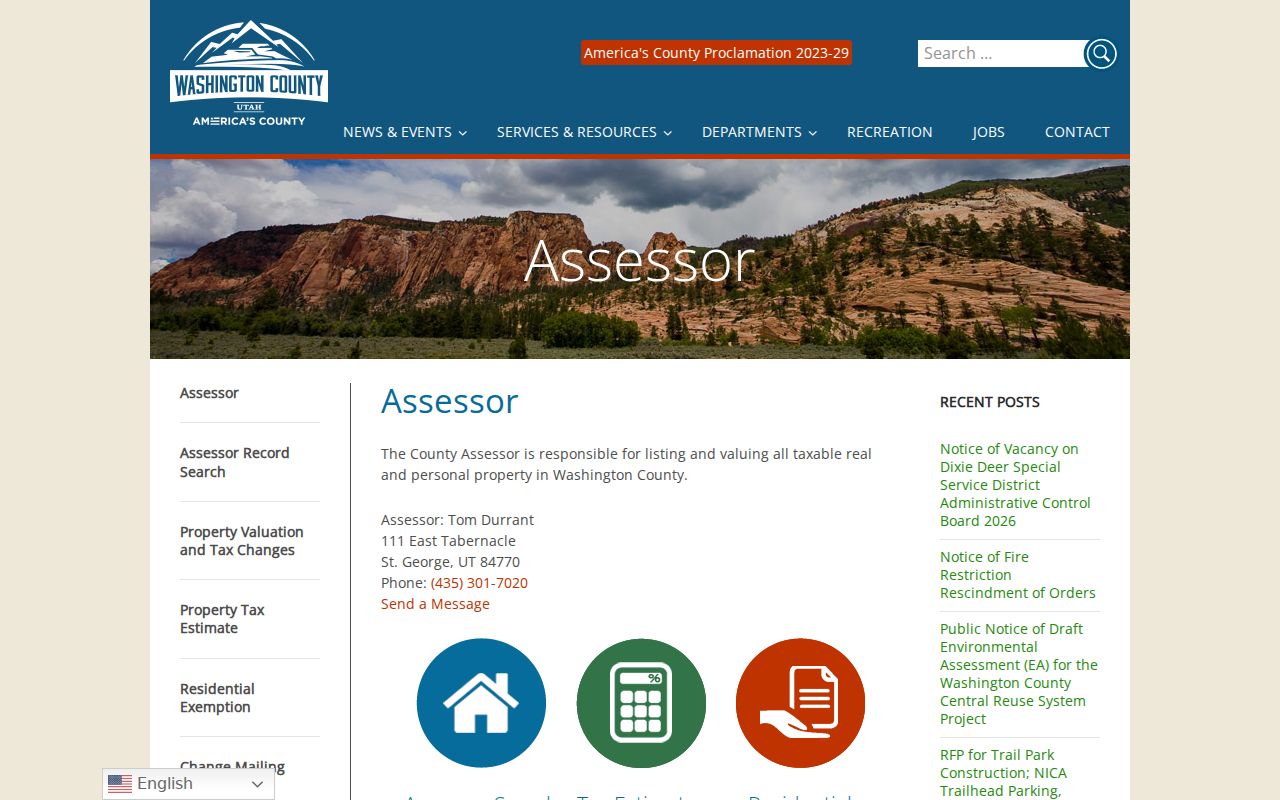
The Washington County Assessor is the official starting point when a Hurricane residents directory search has an address but no reliable surname.
Washington County’s Instrument Index
The Recorder Document Search is broader than a simple deed lookup. It accepts an entry number, last and first name, parcel number, recording-date range, subdivision, lot, block, unit, PLSS fields, legal text, book and page, and range values. The document selector reaches deeds, trust deeds, mortgages, releases, easements, plats, liens, judgments, court orders, historical documents, assessor scans, water-right deeds, and mining records.
| Search path | Best use | What to save |
|---|---|---|
| Parcel number | Follow a modern property trail | Parcel, instrument, date, parties |
| Name with normal or advanced type | Find recorded parties | Spelling, role, document type |
| Subdivision, lot, block, unit | Narrow a named development | Legal description and result |
| PLSS or legal text | Bridge older descriptions | Section, township, range, text |
The current Recorder fee reference verifies $45 for a document amount plus $2 for each legal description over ten. Exact online-image and certification amounts were not located in the inspected text, so confirm them before ordering. The index is a finding aid. An image or certified copy is the record to cite when the detail matters.
The Washington County Recorder search shows why a Hurricane residents directory trail can move from an address to names and legal descriptions.
Reading Hurricane’s Street Grid
Hurricane addresses are easier to reconcile when State Street or SR 9 and Main Street are treated as local reference lines. The Utah address-system material identifies those roads as the origin of the city’s directional grid. A number that looks incomplete may need a north, south, east, or west prefix, and a historical clipping may use a former street reference. Keep the original wording while also searching the current parcel and subdivision.
Postal geography adds another layer. ZIP 84737 maps to Hurricane, but a ZIP is not a city-limit polygon. Annexation planning and city GIS are better sources for municipal boundaries. When a record says Washington, La Verkin, Virgin, or St. George, do not assume the person or parcel is in Hurricane without checking the address and jurisdiction.
The Washington County GIS Viewer gives parcel and city-limit context for a Hurricane residents directory search.
Checking Hurricane Court Records
Hurricane Justice Court serves Hurricane and La Verkin. The city describes matters involving adults, class B and C misdemeanors, infractions, and municipal ordinances. Public case information is searched through Utah State Courts Xchange, not through the county Clerk. Choose Justice Court, Washington County, or both before searching. A name-only result is not enough because case numbers are not unique statewide and names can collide.
Xchange accepts a case number, last name or company, first name, case type, jurisdiction, county or court scope, and optional birth date, citation number, citation location, and date range. It supports an asterisk wildcard. The result can show county, court, case type, case number, filing date, parties, birth date when available, party code, case history, and documents. Results are capped at 500. Guest access lists a $10 one-time account, $0.20 searches, and $1 documents, with a monthly option.
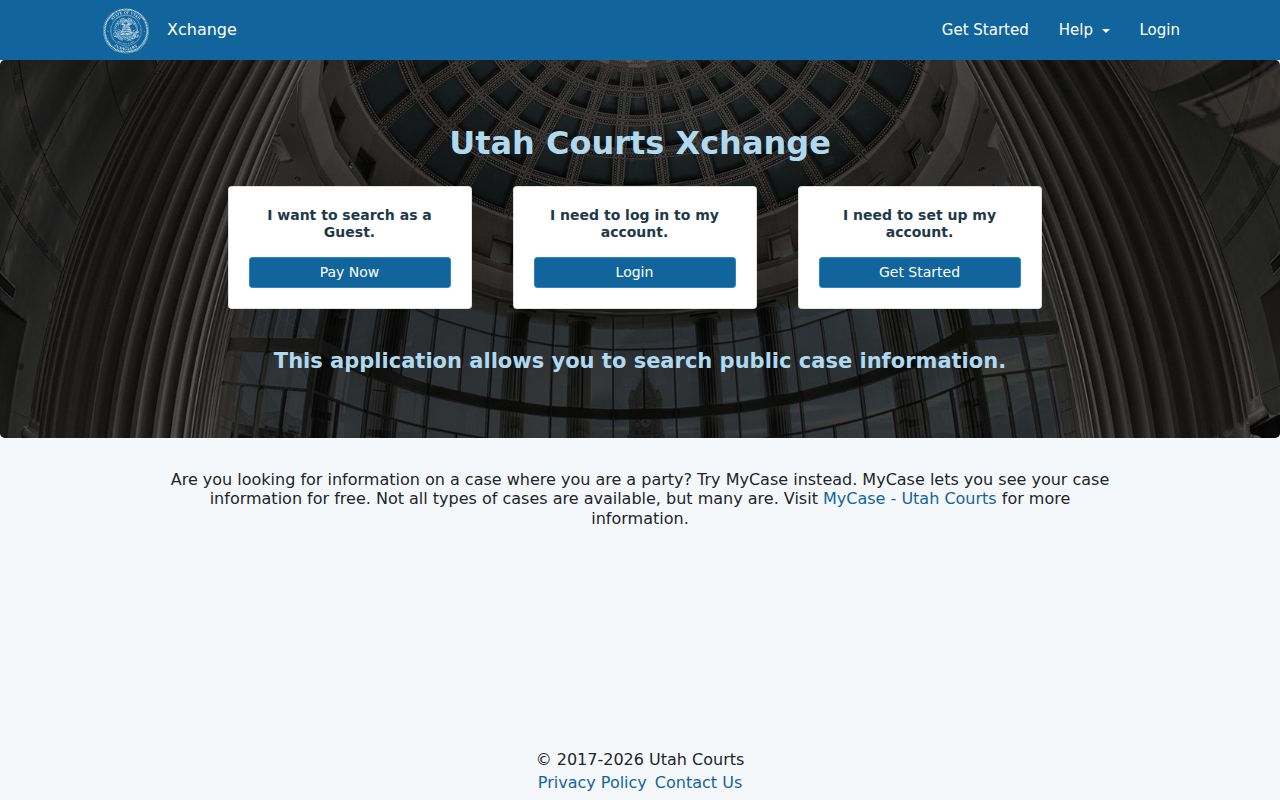
The Utah Courts Xchange portal explains the public case-history route used for Hurricane court research.
Newspapers and Hurricane School Years
A continuous printed city-directory run was not verified. The stronger local-history substitutes are the Washington County News, the Washington County Historical Society index, and Utah Tech’s WASH-031 yearbooks. The newspaper corpus begins in 1898 and contains Hurricane items even though its catalog city facet often says St. George. Search the paper and county, then inspect the page image because OCR may miss names, streets, and punctuation.
Hurricane High volumes verified in the finding aid include The Cyclone from 1928, Fault Finder from 1930, The Hurricana from 1931, Red and Black from 1938, and Typhoon from 1941. These can reconnect a name with a school cohort or activity. They show historical association, not current residence. The Hurricane Branch Library is a local referral point; ask staff to confirm where newspaper microfilm and local-history files are held.
Vital Records and Eligibility
Utah’s release rules decide which vital route is appropriate. Birth records become public after 100 years, death records after 50 years, and marriage or divorce records after 75 years. Earlier certified copies require a direct tangible legitimate interest and identity or relationship documentation. The Utah Office of Vital Records and the Southwest Utah Public Health Department handle state and local routes, while the Washington County Clerk handles marriage-license issuance and county marriage-copy requests.
An index mention, newspaper announcement, or cemetery entry can supply a lead without granting access to a certified certificate. Ask for the smallest record needed and keep the date, relationship basis, and request route in the research note. A cemetery interment can help connect a former resident to a family, but it does not prove that the person lived at the nearby address.
What Utah Voter Records Reveal
The Utah voter status route can support a narrow address or status check. Public fields include name, physical and mailing address, age range, party affiliation, and vote history, subject to withholding and at-risk protections. Full date of birth, identification numbers, Social Security number, phone, email, and signature are private. Vote history indicates whether a person voted, not how that person voted.
Exact status-form field labels were not exposed in accessible official text, so do not promise a particular search control. Use the official state route and record its date. Never combine a public voter field with a property name as if it were a verified household profile.
Hurricane City Sources Are Narrow
The Hurricane staff directory accepts Category, First Name, Last Name, and Search. It is useful for finding the official who holds a city record. The city business directory uses A-Z or ALL filters, a name field, and a category selector, and displayed 1,913 listings at inspection. A listing may show an organization, address, phone, email, or fax. Neither directory is a complete resident roll.
Building and code records add address evidence. The Building Department links to CityInspect and lists the 2021 IRC, 2021 IBC, and 2020 NEC as effective July 1, 2023. The accessible text did not expose CityInspect’s public search fields, historical coverage, or name display. The cemetery page offers an online Cemetery Web Map, but its exact query controls also need live confirmation.
The Washington County Historical Society adds a local-history finding aid to the Hurricane residents directory trail.

A Recent Archive Doorway
The update is timely for family-history work because it joins a searchable name index to direct image links. Save the index wording, series title, image reference, and access date. If a birth entry points to a residence, use that field as historical context and do not treat it as a current address.
On August 4, 2026, the Utah State Archives announced index updates, including a new Index to Washington County Birth Registers and Washington County Birth Reports with direct digital-image links. The documented birth-register series covers 1898 through 1905 and includes child, parent, residence, and attendant fields. That is a stronger historical resident lead than a generic people-finder result.
Use the archive index to locate a name, then read the image and cite the series. For later events, move to the state vital office, county Clerk, newspaper, or local collection based on the event date. A digital index is a doorway, not proof that every person in the county appears in it.
The Hurricane Branch Library is a practical referral point for local-history and newspaper research.
Privacy Boundaries for a Directory
Utah’s Safe at Home program gives eligible survivors a legal substitute address and mail forwarding. The actual home and mailing address, city or county of residence, precinct, phone number, and unique location information are protected. A public directory must not try to reverse a substitute address. Voter withholding also covers qualifying at-risk people, including certain violence victims, law-enforcement officers, protected-order subjects, armed forces members, public figures, and people living with a qualifying person.
GRAMA is Utah’s public-records framework under Title 63G, Chapter 2. Identify the custodian, classification, and smallest reasonable record before making a request. If a record is redacted or unavailable, that usually says something about the record’s classification or the portal’s limits, not about the person.
Keep the Official Trail Intact
A reliable Hurricane residents directory note names the source, search field, result, access date, and next verification step. Distinguish an index from an image, an owner from an occupant, a party from a defendant, a voter field from a ballot choice, and a newspaper mention from a certified vital event.
- Parcel
- A mapped property unit identified by the county, often carrying an account or parcel number.
- Legal description
- The boundary language used in a deed or plat, which may outlast a street-name change.
- Disposition
- The court’s recorded outcome or later status, not merely the fact that a case was filed.
- Certified copy
- A copy issued by the custodian with certification that it is an official copy.
When a search is for family history or a house story, retain the narrow result and stop when the question is answered. If a record affects another person’s safety, leave the protected detail with the custodian and use only the public process that applies.